
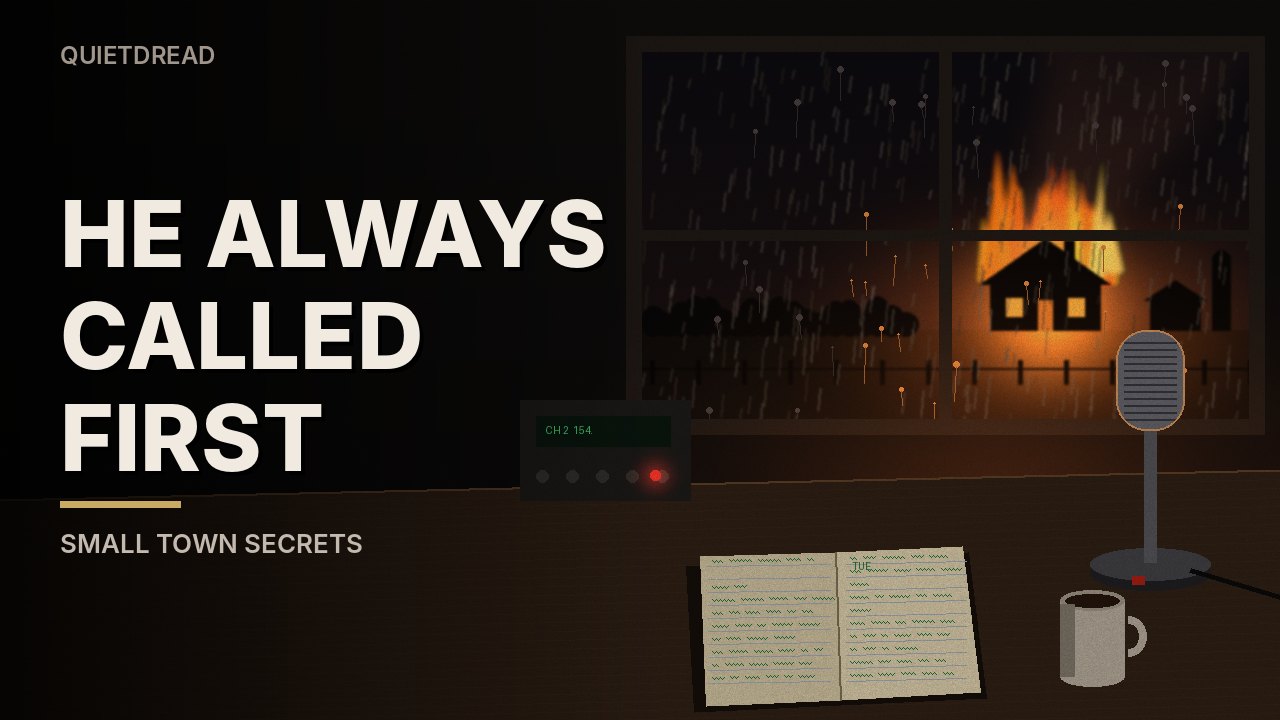
My grandmother’s deathbed confession is the only small town horror story I know that comes with time stamps. Every fire in our town started on a Tuesday, and the fire chief everybody loved always called it in before anyone else saw smoke.
My grandmother told me the worst thing she ever did eleven days before she died, and she told it like she was reading me a grocery list.
This was the spring of 2019. I was forty-six, living in Springfield, Missouri, and working as a property insurance adjuster, which mostly means I look at burned kitchens and water-stained ceilings and decide what a company owes people. Every other weekend I drove two hours north to Halleck, the town where my dad grew up, to sit with Grandma Opal while the hospice nurse took her days off.
Halleck had about nineteen hundred people back then and maybe fifteen hundred now. It has a grain elevator, a Gas-N-Go, three churches, and a water tower somebody painted a smiley face on in 1977 that the town never bothered to paint over. Everybody has a nickname. My grandmother’s was “Night Owl,” because from 1981 to 1990 she was the overnight dispatcher for the Pruett County Sheriff’s Office, which sat in the basement of the old courthouse on the square.
She worked eleven at night to seven in the morning, four nights a week, for nine years. She answered the phone, ran the radio, and kept the log. She kept the log in green ink. When I was little I asked her why, and she said the sheriff told her on her first night that black ink was for deputies and blue ink was for him, and she didn’t care for either of them, so she bought her own pens.
I thought that was just Grandma being Grandma. It turned out to matter a lot.
That Saturday I was cleaning out her hall closet, because my aunt wanted the house ready to list, and I found a cedar box on the top shelf.
Inside were carbon copies of dispatch log pages. Dozens of them. All green ink. All dated in the 1980s.
I brought the box to her bed and asked if she wanted me to throw it out.
She looked at it for a long time. Then she said, “You look at fires for a living, don’t you, Wade.”
I said I did, sort of.
“Then sit down,” she said. “And don’t interrupt me. I’ve only got so much air.”
Here’s what she told me.
In the 1980s, Halleck had a bad run of house fires. Everybody old enough remembers it. The feed store went in 1983. A barn on the Kessler place in 1984, then two empty rental houses on Cherry Street that same winter.
In 1986 the Purcell farmhouse out on Route J burned to the foundation, and the Purcells only got out because their dog wouldn’t stop barking.
People had theories. Old wiring. Space heaters. Kids smoking.
Somebody at the Methodist church said it was a judgment, though nobody could agree on what for.
What nobody said out loud, at least not at first, was that every one of those fires started on a Tuesday night.
The Chief Everybody Called Dutch
The fire department in Halleck was all volunteers. The chief was a man named Lyle Bramwell, but nobody called him Lyle. They called him Dutch, after a dog he had as a kid. Dutch ran the hardware store on the square.
He coached Legion baseball. He was the one who climbed the water tower every Fourth of July to hang the flag.
When my dad was sixteen and wrecked his truck in a ditch, it was Dutch who pulled him out and drove him home and never told my grandfather it had been beer and not ice.
And Dutch was always first on scene. Always. People used to joke that he slept in his turnout gear.
The Pruett County Crier ran a photo of him in 1985, soot on his face, holding a cat he’d carried out of one of the Cherry Street houses. The headline was “Our Dutch.” I remember that picture hanging in the Gas-N-Go for years.
Grandma said Dutch used to bring her a paper sack of horehound candy every Wednesday morning, right around six, when he opened up the hardware store. “For the night shift,” he’d say. She hated horehound. She ate it anyway, because it was Dutch.
“It took me three years to notice,” she told me. “The candy only came on Wednesdays after a fire. Not every Wednesday. Just those.”
I told her that could be a coincidence. Maybe he came by after fires because he’d been up all night anyway.
She gave me a look I hadn’t gotten since I was nine.
“I said don’t interrupt.”
The Small Town Fire on Route J
The night that changed it for her was Tuesday, March 11, 1986.
She said it was a quiet shift. One drunk driver call early, nothing after. She was doing a crossword and drinking coffee out of the thermos she always brought, and the radio had been dead for over an hour.
At 2:14 a.m. the radio clicked.
“Pruett, Halleck One.” That was Dutch’s call sign.
“Go ahead, Halleck One.”
“I’ve got smoke showing at the Purcell place on Route J. Go ahead and tone it out.”
She wrote it down. 0214. Green ink. She toned out the volunteers, and she heard the siren start up on the square above her, that long rising wail you could feel in the floor.
Then, at 2:19, the phone rang.
It was Ardith Pike, who lived a half mile past the Purcells. She was screaming that the Purcell house was on fire, that she could see it from her kitchen.
Grandma told her help was already on the way. Ardith said, “How? I’m the closest house.”
Grandma said she sat there with the phone in her hand and her pen still on the paper.
Because she knew Route J. Everybody did. Dutch lived on the north end of it, three miles up, and between his place and the Purcell farm there’s a ridge. Pike’s Hill.
You can’t see the Purcell place from anywhere on the north side of that ridge. You couldn’t then and you can’t now.
There was one more thing. She made me promise to write this part down exactly, so I’m writing it exactly.
When Dutch keyed the radio at 2:14, she didn’t hear his truck.
No engine, no road noise, no wipers, and it had been drizzling. What she heard behind his voice were spring peepers. Those little frogs that start up in March in the ditches and the ponds. Hundreds of them, that high sleigh bell sound.
He wasn’t driving when he called it in. He was standing outside.
Somewhere close to water.
The Purcells had a stock pond about forty yards from their back porch.
Grandma said the rest of that shift was the longest four hours of her life. The Purcells got out. Their dog got out. The house was gone by sunrise.
At 6:02 a.m., Dutch came down the courthouse steps to sign the incident log, the way the chief always did. He set a paper sack of horehound candy on her desk. His coat was still on. She said he smelled like wet smoke and kerosene and something sweet underneath it, like the candy.
He signed the log. Then he looked at the column where she’d written his radio time, and he tapped it with one finger.
“You keep real good time, Opal,” he said.
That’s all he said. Then he smiled and went up to open the hardware store.
She said she’d known that man for thirty years and she had never once been afraid of him until he said that.
She Kept Time in Green Ink
So she did what she knew how to do. She kept time.
She went back through her own carbon copies. She’d kept them for years, she said, out of spite for the sheriff, because he lost things.
Every fire since 1983 that she’d worked was in there. And every single one, Dutch had called it in himself before anybody else did.
Two minutes ahead. Four minutes. Once, on the Cherry Street rentals, eleven minutes before a neighbor called.
Every one of them was a Tuesday.
I asked her why Tuesdays. She said she’d thought about that for thirty years and the closest she ever got was that Tuesday was the night his wife, Marlene, drove to Kirksville to sit with her mother at the nursing home. She stayed over. Tuesday was the one night of the week Dutch was alone in that house with nobody to notice when he went out or when he came home.
Grandma didn’t think it was about money, though two of those properties had insurance policies that paid out pretty well.
She didn’t think he hated anybody. She said she thought he just loved being the one who came running. Loved the picture in the paper. Loved the cat in his arms.
But she said that’s only a guess, and she’d be dead soon and couldn’t be held to it.
I asked why she didn’t go to the sheriff right away.
“The sheriff,” she said, “was Marlene’s cousin.”
She sat on it for two more years. She said that was her first sin and she knew it.
In October of 1988, a little house out past the grain elevator burned on a Tuesday night. It belonged to a man named Arlo Teague.
Arlo was the town problem. He drank, he shot at stray dogs, he’d been banned from two of the three churches and the Gas-N-Go. People called him Arlo the Mouth.
When his place burned, Arlo didn’t get out.
Dutch called it in at 1:41 a.m. The first neighbor called at 1:47.
Grandma said the next morning at the post office she heard two women talking about Arlo, and one of them said, “Well. Nobody’s going to miss the noise.” And the other one laughed.
That’s when she took the box to the mayor.
The mayor then was a woman named Bev Ostrander, who ran the beauty shop and had been in Grandma’s wedding. Bev read every page. She called in the sheriff and two men from the town council, and they met in the back room of the beauty shop on a Sunday afternoon with the blinds down.
Grandma wasn’t invited to stay. She sat out front under a hair dryer that wasn’t turned on.
Three weeks later, Dutch Bramwell announced his retirement as fire chief. There was a pancake breakfast at the Legion hall. The high school band played.
They gave him a plaque and an old brass fire bell mounted on a walnut board.
The Crier ran a full page. “Thank You, Dutch.”
He was never charged with anything. Nobody ever said the word arson in public. Arlo Teague’s death was ruled accidental, a space heater, and there was no family to argue about it.
Grandma said Bev told her afterward, “It’s handled, Opal.
What good would a trial do? Tear the whole town in half? He’s done now. It’s over.”
And the fires did stop. That part held.
What She Really Wanted to Tell Me
I sat there next to her bed thinking that was the end of it. I was already halfway to being mad at a town full of people who were mostly dead.
Then she said, “That isn’t what I wanted to tell you.”
She asked me to hand her the water. She drank a little. Her hands were shaking but her voice wasn’t.
“Dutch’s own house caught fire in May of 1989,” she said. “On a Tuesday.”
I didn’t say anything.
“Marlene was in Kirksville. The call came in at 1:50 in the morning. It was the neighbor, the Holt boy, grown by then. He said the Bramwell place was burning and he could hear Dutch inside yelling.”
She looked at the window, not at me.
“I finished my coffee,” she said. “Then I toned it out.”
I asked her how long.
“Four minutes,” she said. “Same as he used to give himself.”
The volunteers got there. They got Dutch out through a bedroom window. He had burns on both hands and he never used them right again.
He and Marlene moved to their daughter’s place in Tulsa that summer, and he died there in 1996.
Nobody in Halleck ever found out who started that fire, or if anybody did. The fire marshal from the county wrote it up as electrical.
“I didn’t light anything, Wade,” she said. “I want you to know that. I’m just telling you what I did. I took my time.”
Then she closed her eyes and said she was tired, and that was the last time we talked about it.
She died eleven days later. It was a Tuesday. I checked.
I kept the box. I’ve read every page in it more times than I can count, and as an adjuster I can tell you the numbers in that green ink are as clean as anything I’ve ever seen in a claim file.
Two minutes. Four minutes. Eleven minutes. Six minutes for Arlo Teague.
And then, on the last page, in her handwriting, the one entry I keep going back to.
0150 call rec’d, Bramwell res. 0154 toned out.
The whole town knew what Dutch was and decided four minutes of silence was fair. They gave him pancakes and a plaque and a quiet life in Oklahoma. My grandmother gave him exactly the same thing he gave Arlo Teague.
So I’ll ask you what I’ve been asking myself for six years. If the people who were supposed to stop him wouldn’t, and she was the only one left holding the clock, was she wrong to let it run?
Have a small town horror story of your own?
Every place has small town secrets nobody says out loud. If you grew up with a small town horror story, or a family secret that only came out at the very end, tell us in the comments below.
How scary was it?
More Small Town Horror Stories
 Our HOA Cited Us for Things You Could Only See From Inside Our House
 Three Bus Passengers Got Off for Pie at June’s Cafe and Never Got Back On
 The Last Family in Fenwick Never Left the Town Under the Lake
 Every Clock in Our Town Runs Eleven Minutes Slow on Purpose
 Our Sheriff Made Up the Ghost on the Gilly Creek Bridge
 Our Neighborhood Watch Captain Kept a Notebook on Every House