
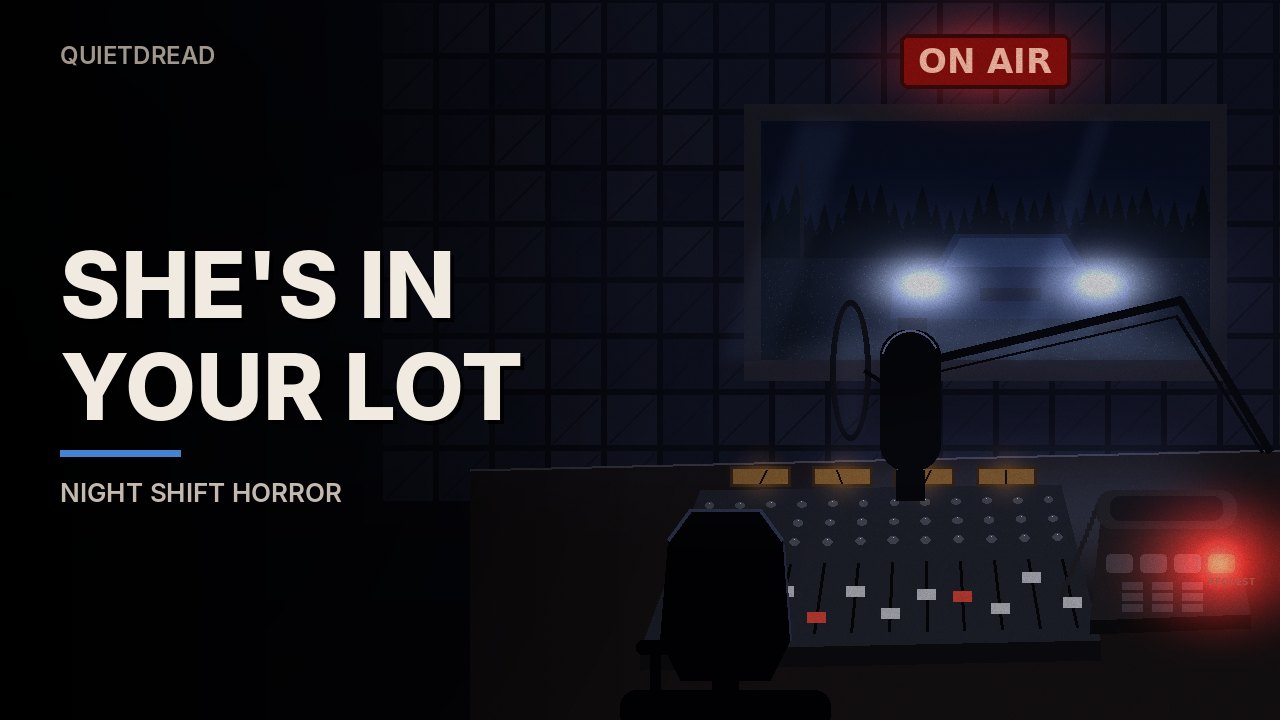
This late night radio horror story begins with a sweet little song dedication for the woman in the blue Corolla. Then the caller kept phoning back to tell me exactly where she was driving, and I kept reading it on the air.
I hosted overnights at a small radio station in south Georgia for three years, and there’s one night of airchecks I’ve never been able to throw away.
This was 2009. The station sat on a gravel lot off Highway 84, about four miles outside a town called Harlow, which you’ve never heard of, and that’s fine. We played classic country and old soul.
From midnight to five it was just me. No producer, no call screener. A mixing board, two CD players, a computer that ran the ads, and a desk phone with four lines and a red light that blinked when somebody called the request line.
I took the job because I’d wanted to be on the radio since I was nine, and overnights were the only slot open. It paid eleven dollars an hour. I told people I was “in broadcasting.”
Overnights in a town like that, you get the same callers. Truckers. Nurses driving home from the hospital in Bainbridge. A man named Otis who called every night at one to ask for Bobby “Blue” Bland and tell me about his tomatoes.
You get to know them by voice. That was the best part of the job. Feeling like you were keeping a few people company in the dark.
That week there’d been a new one.
Tuesday night a man called in, polite, soft-spoken, and didn’t want a song. He just wanted to chat. Asked how long I’d been doing the show, if it got lonely out there, what I drove.
I said a white Ford Ranger with a bad muffler, you can probably hear me coming from Tallahassee. He laughed at that. Said, “I’ll listen for it.”
Then he said have a good night and hung up.
I didn’t think twice. People are lonely at night. That’s who listens.
A Late Night Radio Request
Thursday, a little after two in the morning, the request line blinked.
“Request line, you’re talking to Royce.”
That was off the air, you understand. I always picked up off the air first.
It was a man. Calm, quiet. I didn’t connect him to Tuesday, not then.
He said, “Could you play ‘Rainy Night in Georgia.’ For the woman in the blue Corolla.”
I said sure. I asked if he wanted to say who it was from.
“No. Just say she’s on 84 heading east, just past the Dollar General. Say she’s doing fine.”
I figured it was a husband. Or a boyfriend who’d had a fight with her and wanted to say sorry without saying sorry. That kind of thing happened more than you’d think.
When the song came up I read it the way he said. “This one goes out to the woman in the blue Corolla, eastbound on 84 just past the Dollar General. Somebody says you’re doing fine.”
It felt sweet. I want to be clear about that. It felt sweet.
At 2:40 the line blinked again.
Same voice. “Could you play ‘Tennessee Whiskey.’ For the woman in the blue Corolla. She just turned onto Spring Creek Road. Tell her she’s got her high beams on, and she doesn’t need them.”
That was a little strange. But I made it make sense. He was following her home. Making sure she got there safe. Maybe he was in the car right behind her, watching her taillights and being cute about it.
I read it on the air. High beams and all.
At 3:15 it was “Behind Closed Doors.”
“She’s stopped at the four-way at Spring Creek and Lyle. She’s been sitting there a while. She keeps checking her mirror.”
I asked him, off the air, “Hey, man. Are you with her?”
He said, “Just read it, Royce.”
I let that go too. Of course he knew my name. I’d just said it when I picked up.
I read it on the air. But I left out the part about the mirror.
I tried to see his number. The station was old enough that caller ID was a little gray box screwed to the wall, and it said UNKNOWN for every call that night. Half the county had blocked numbers. I didn’t think much about that either.
Four Minutes on That Song
At 3:50 the line blinked, and I almost didn’t pick up.
“‘Help Me Make It Through the Night.’ For the woman in the blue Corolla. She turned around. She’s coming back up 84 now, westbound. She’s driving too fast for those tires.”
I said, “Who is this?”
He said, “You’ve got about four minutes on that song. Play it.”
I thought about not playing it. I thought about calling the sheriff. I actually picked up the second line to do it, and then I put it back down.
What was I going to say? A man keeps dedicating songs to a woman in a Corolla? I didn’t have a name or a plate. I didn’t know if she was in trouble or if this was some game between two people I didn’t understand. And the sheriff’s office out there had a reputation. You call them at four in the morning about a love song, you get laughed at. If they come at all.
So I played it. And I read it word for word, because I didn’t know what else to do. Part of me hoped she was listening. That she’d hear it and understand somebody was watching her, and she’d go somewhere safe.
I found out later that’s exactly what she did.
I don’t know how to explain the studio after that. It’s a small room with carpet on the walls to kill the echo. You can feel the transmitter through the floor, a low hum, like a big refrigerator. I’d been listening to that hum for three years. That night it sounded like something breathing under the building.
At 4:11 the line blinked.
I picked up and didn’t say anything.
He didn’t either, at first. I could hear him breathing. And under his breathing I could hear something else. A low, steady hum.
The same hum that was coming up through my feet.
He said, “Play something nice. For the woman in the blue Corolla. She just pulled into the station lot. She’s parked next to the white Ranger.”
I set the phone down on the board without hanging up.
Headlights in the Station Lot
The studio has one window. It looks out on the lot. I turned my chair, and there were headlights out there. A small car, nosed in right beside my truck. Blue. Engine running.
The driver’s door opened and a woman got out and ran for the building.
Then she was pounding on the front door glass with both hands, yelling, “Please, please, is somebody in there,” and I was running down the hall to let her in.
I locked the door behind her. She was maybe forty, in hospital scrubs, with her keys still in her fist so tight they’d cut her palm a little.
She said a truck had been behind her since Bainbridge. It had followed her onto Spring Creek Road and sat behind her at the four-way with its lights off. When she turned around, it turned around.
And her radio was on the whole time. She’d heard me reading where she was. Every turn.
“I didn’t know where else to go,” she said. “You were the only one I knew was awake.”
Her name was Dolores. She was a night nurse. She had never called the station in her life.
We called the sheriff from the front office. It took them twenty-six minutes.
While we waited, I went back into the studio. Dead air is the one thing they teach you never to allow, and some stupid part of my brain still cared about that.
The phone was lying on the board where I’d left it. The line was still open.
I picked it up. The hum was there. Through the phone and through the floor, both at once.
I said, “The police are coming.”
He said, “That’s fine, Royce. You did good tonight.”
Then he hung up. And through the studio window I watched a pair of headlights come on at the far end of the lot, back by the tower fence, where there’s no road. They’d been sitting there dark. They backed out slow, onto 84, and went east.
The deputies took our statements and walked the lot with flashlights. They found tire tracks by the tower fence, which didn’t mean much on gravel. They never found the truck.
They had me write down everything I remembered about the calls. I gave them the Tuesday call too, the friendly man who asked what I drove. They wrote it down without saying anything.
Dolores moved to Valdosta that winter. She sent a card to the station at Christmas. It just said, “Thank you for reading them.”
Nobody ever found out who he was. I’ve listened to those airchecks more times than I can count. The calls never went out on the air, so all I have is my own voice reading his words. “She’s doing fine.” “She doesn’t need her high beams.” You can hear me getting more scared each time. And you can hear that I read every one anyway.
There’s one thing I never told the deputies, because I didn’t put it together until months later.
That Tuesday caller, the friendly one. Right before he hung up, he asked me one more question. He asked what time I got off.
I told him five.
I quit radio in 2011. I drive a different truck now, and the muffler’s fine. I don’t take requests from anybody. Not even at weddings.
But when I’m driving home late with the radio on and a DJ starts reading a dedication, I still check my mirror.
Have a late night radio horror story of your own?
Have you ever worked overnight alone and taken a call you couldn’t forget? Tell us your late night radio horror story, or any radio horror stories from the graveyard shift, in the comments below.
How scary was it?
More Night Shift Horror Stories
 The Lock on Storage Unit 114 Changed Every Night on My Shift
 Our Funeral Home Van Drove Itself 14.6 Miles Every Night
 A 911 Call Came From Inside Our Dispatch Center at 3:02 Every Night
 Corporate Kept Calling the Gas Station at 2 A.M. to Send Me Outside
 There Was One More Actor on the Hayride Than We Hired
 3 True Night Shift Horror Stories That Still Keep Me Up