
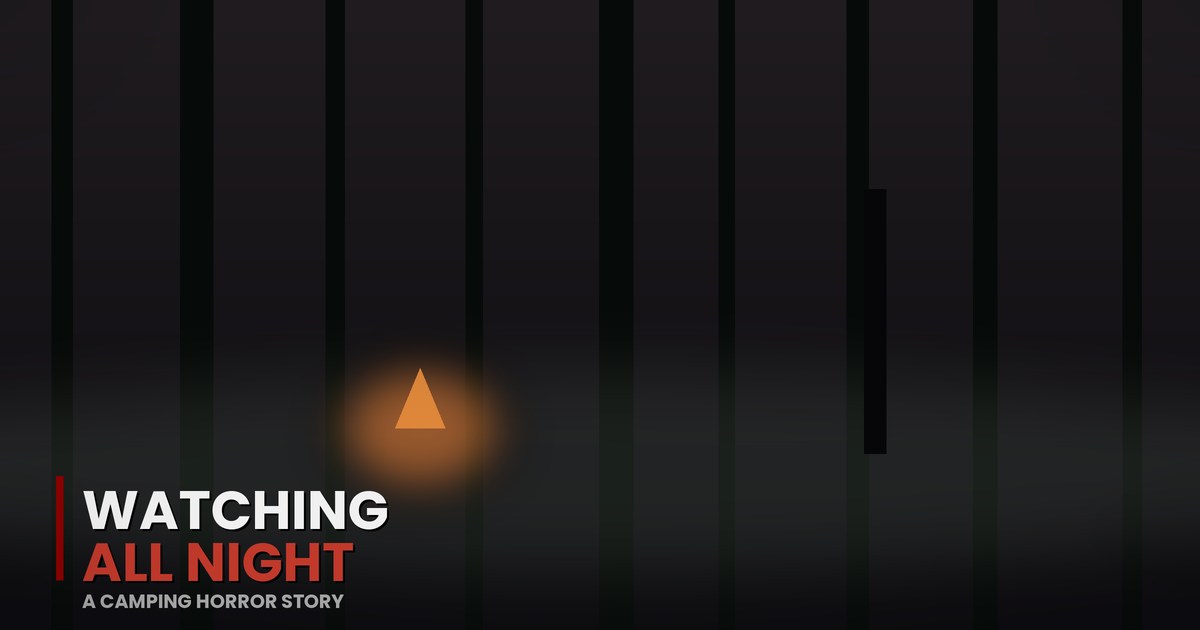
You can feel it when something is watching you. It’s an old instinct, older than language itself, buried somewhere deep in the animal part of your brain. The thing watching our campsite that night woke that instinct in all five of us at once, and none of us wanted to be the first to say it out loud.
It started around eleven at night. There were five of us gathered around a dying fire, trading stories, laughing, passing a flask. And then the conversation just… stopped. All of us at once, mid-sentence, like we’d each noticed the same thing at the exact same moment. The unmistakable feeling of eyes on the back of your neck.
Jordan was the one who finally whispered it. “Does anyone else feel like we’re being watched?” Nobody laughed. Every single one of us nodded.
The Shape at the Edge of the Light
We built the fire back up, big and bright, pushing the darkness back as far as we could. And there, at the very edge of the firelight, right where the warm glow faded into black trees, we could see the shape of it. Not clearly. Just an outline. Tall and narrow, standing perfectly still between two trees, right at the border of what the light could reach. It didn’t move. It didn’t make a sound. It just stood there, and watched, and waited.
Here’s the part I still can’t shake: every time the fire dimmed, even for a second, the shape seemed closer. We never actually saw it move. But in the moments our eyes couldn’t quite catch it — when the flames guttered, when someone looked away to grab more wood — it had advanced. A few feet each time. Silent. Patient.
What We Found at Dawn
We kept that fire roaring all night long. We took turns in pairs, two of us awake at all times, feeding it branch after branch, never once letting it drop low. And the thing stood at the edge of the light the entire night, matching us, waiting us out. It had the patience of something that knew it had all the time in the world, and knew that we did not.
At the first gray light of dawn, Jordan looked up and said, “It’s gone.” And it was. The space between the two trees was simply empty, as if nothing had ever stood there. We broke camp in record time, barely speaking. As we packed, I made myself walk over to the spot where it had stood all night, telling myself I’d imagined the whole thing, that there’d be nothing there to find.
The pine needles were flattened in a single spot, right between the two trees. Pressed down hard, the way the ground looks when something heavy has stood in exactly one place for a very long time. And when I crouched to touch the earth there, it was cold. Not cool morning dirt — winter cold. Deep, aching, impossible cold, in the middle of July. We never camped in that forest again. And some part of me is still sitting at that fire, feeding it branches in the dark, watching the shape at the edge of the light watch back. I’ve gone camping since, but only in open campgrounds, close to other people, with the kind of bright electric lights that leave no shadows at the treeline. Because I understand now that the worst thing in those woods wasn’t that it watched us. It was how patient it was — how it was content to simply wait, all night, certain that sooner or later the fire would go out. Ours didn’t. I think about the people whose fires did.
How scary was it?
More Scary Camping Stories
 Every Morning There Was a New Roasting Stick Carved With One of Our Initials
 Someone Marked My Trail With Orange Ribbons While I Walked It
 An Empty Tent Moved Closer to My Ranger Cabin Every Night
 A Park Ranger’s Warning: Don’t Follow the Stairs
 We Heard Something Imitating Our Voices in the Forest
 The Cabin in the Woods That Shouldn’t Exist