
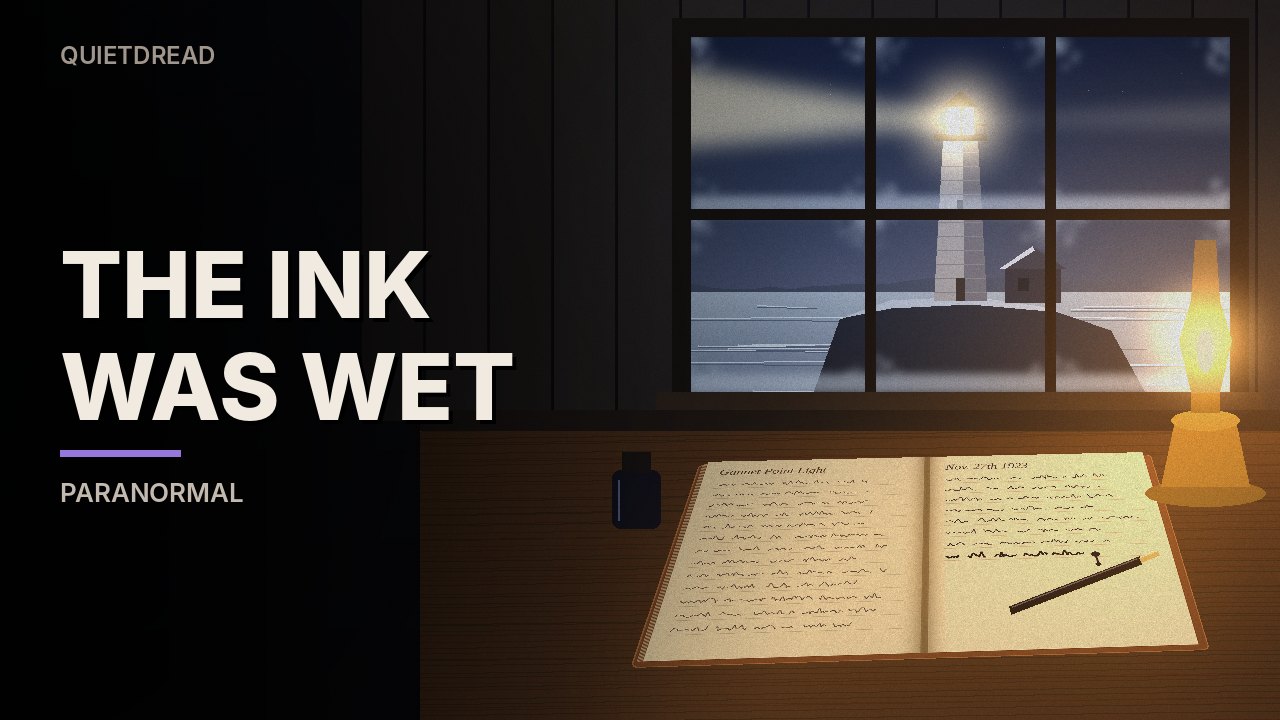
This lighthouse ghost story started with a cardboard box from an estate sale and a logbook that should have been in the National Archives. The keeper of Gannet Point was lost on Lake Superior in November 1923, but the entries in his handwriting went on for three more days.
I volunteer two afternoons a week at a county historical society on the south shore of Lake Superior, in Michigan’s Upper Peninsula. Most of what I do is boring, and I like it that way. I scan photographs of logging camps. I type up church records. I answer emails from people in Arizona who think their great-grandfather might have owned a sawmill.
I’m a dental hygienist the rest of the week. I started volunteering after my divorce because the building was quiet and smelled like old paper, and I needed somewhere to be on Tuesdays.
In February of last year, a woman from Ishpeming dropped off three boxes from her aunt’s estate. Her aunt had been a schoolteacher, and the boxes were mostly lesson plans and Christmas cards.
At the bottom of the third box there was a logbook.
Brown cloth cover, water-stained, the spine taped with something that had turned the color of tea. Stamped on the front, very faint: U.S. LIGHTHOUSE SERVICE. And under it, in ink: GANNET POINT LIGHT STATION, 1921 to 1924.
I knew Gannet Point. Everybody up here does. It’s a little stone tower on a spit of rock about eleven miles east of town, automated since the sixties. There’s a plaque by the parking area that tells you about Keeper Halvard Nyberg, who was “lost on the lake in the performance of his duty” in November of 1923.
Logbooks like this were federal property. They were supposed to go back to the government. This one never had. And it turned out the aunt was Nyberg’s granddaughter.
So I took it home over a weekend, with the director’s permission, and I read it. That was the start of about eight months of work, and I want to lay it out the way it came to me.
First, the official story.
The plaque, the 1923 newspaper, and a short history the society printed in 1976 all say the same thing. On the night of November 19, 1923, a northeast gale hit the south shore. A fishing tug, the Elsie M., was reported in trouble off Gannet Point. Keeper Nyberg took the station boat out to help. Neither he nor the boat came back. His body was never recovered. His assistant keeper, a man named Ernest Brisbois, kept the light burning alone through the storm.
Nyberg’s widow, Inga, got a pension. The Lighthouse Service put a short notice in its bulletin. That was it. A brave man and a bad night.
It’s a good story. I believed it for about a week.
The First Crack in the Logbook
The first crack was the logbook itself.
Keepers wrote in the log every day. Weather, wind, time the light was lit, time it was put out, supplies, visitors. It’s dull reading, and that’s the point. The log is how the government knew the light was being kept.
Nyberg’s handwriting is easy to spot. He slanted hard to the right. He crossed his sevens. And he always wrote “lighted,” never “lit.” Brisbois wrote small and straight up and down, and he wrote “lit.”
The entry for November 19 is in Nyberg’s hand.
“Wind NE strong. Heavy sea. Snow. Lighted 4:20 p.m.”
Nothing about a tug. Nothing about a boat.
Then November 20. Nyberg’s hand.
“Wind NE moderating. Snow ending. Lighted 4:19 p.m.”
November 21. Nyberg’s hand.
“Wind NW fresh. Clear and cold. Lighted 4:18 p.m.”
November 22. Nyberg’s hand.
“Wind NW light. Ice forming along the shelf. Lighted 4:16 p.m. Someone on the ice again.”
Then November 23, in Brisbois’s small straight writing.
“Keeper Nyberg has not been seen since the night of the 19th. I have kept the light. Station boat in the boathouse.”
I read that last line about twenty times. Station boat in the boathouse.
What the National Archives Kept
The second crack came from the National Archives. I wrote to them in March and asked for anything filed about Gannet Point in late 1923. In May I got back scans of a two-page report from the district inspector, who came out by train and wagon on December 2.
He notes the keeper is missing and presumed drowned. Then, near the bottom, in a different ink, like he added it after:
“Asst. Brisbois states keeper departed in station boat. Station boat found in its house in good order. Asst. unable to account for this.”
So the boat never left.
The third crack was the Elsie M. I found the tug in a 1923 issue of the town paper, in the shipping notes. It had been tied up in Marquette for the entire storm, waiting out the weather with half a dozen other boats. No tug was in trouble off Gannet Point that night. I checked three times.
The fourth crack came from Brisbois’s side. I found a great-grandson of his in Wisconsin through a genealogy site. He was kind and curious, and he sent me photos of a letter his family had kept. It was from Brisbois’s wife, Marguerite, to her sister in Green Bay. It’s dated November 17, 1923, two days before the storm.
“Mr. Nyberg has not come down from the lantern since Thursday. He has bolted the hatch from above. Ernest leaves his meals on the iron stair and they are taken. He says there is someone on the ice below the tower who watches the light, and that he must count the flashes so the man does not count them first. Ernest says I am not to worry. I do not sleep.”
There it was. Something had been wrong with Halvard Nyberg before the storm ever came.
I went back to the log with that in mind, and I found it there too, once I knew to look. In October of 1923 his entries start to wander. His hand gets shaky. On October 9 he wrote, under the weather, “Counted the flashes twice tonight. They are right.” On October 30, “Someone else counts them too.” On November 6, “Man on the ice at 2 a.m. No ice yet.”
No ice yet. In early November, the lake doesn’t freeze. There was nothing out there to stand on.
A Theory About the Lighthouse Ghost
So here’s what I think happened. This is the part I’m fairly sure of.
Gannet Point had what’s called a mercury float lens, installed in 1914. Instead of turning on gears, the big glass lens sat in a round bath of liquid mercury so it could spin smoothly all night. A lot of lights had them. Keepers worked in that lantern room for hours at a time, in winter, with the windows shut, breathing whatever came off that bath.
Mercury poisoning was a known problem among keepers. Tremors. Shaky handwriting. Paranoia. Seeing things. Sleeplessness. Every sign I’d found in that log.
Nyberg had been in that lantern room for nine years.
I think he was sick, and getting worse, and in November it broke. He locked himself up in the lantern with the light. And sometime on the night of the 19th, or after, he came down and walked out onto the rocks in that gale and into the lake. Maybe after the man he kept seeing on the ice.
And I think Brisbois made up the boat. I don’t even blame him. A keeper who goes mad and walks into the lake is a scandal, maybe a suicide, and in 1923 that could cost a widow her pension. A keeper lost going out to save a tug is a hero. Brisbois gave Inga Nyberg the version she could live on. The town paper printed what it was told, the plaque copied the paper, and the society’s history copied the plaque.
That leaves the three entries in Nyberg’s handwriting after the 19th.
For a while I thought Brisbois forged them, to make the timeline murky. But that didn’t fit. Why fake three days of a man being alive, and then report him gone since the 19th anyway?
The answer I landed on is simpler. Nyberg wrote them himself, ahead of time. A confused, sick man, up in the lantern, sleepless, filled in the next three days of the log before he left. The weather he wrote down was right, but any keeper with a barometer could guess that a northeast gale would swing northwest and turn cold. The lighting times drop a minute or so each day, the way sunset does in November. He’d been writing those numbers for nine years. He knew them.
“Someone on the ice again,” on the 22nd, was just one more line from a man who’d been seeing someone on the ice for weeks.
That was my explanation. Sick man, kind lie, sad ending. I wrote it up for the society’s newsletter. I was proud of it, honestly. It was careful and it was fair to everybody.
A Fourth Box From Ishpeming
Then the Ishpeming woman called.
She’d found a fourth box in her aunt’s garage. Mostly photographs. She said there was an envelope in it with my society’s name written on a sticky note, in her aunt’s hand, like the aunt had meant to send it to us someday and never did.
She dropped it off on a Tuesday in October. I didn’t get to it until after closing.
I remember the building had that cold, closed-up feeling it gets after the furnace kicks down. The radiator under the window was ticking. I sat at the long table in the back with the lamp on and opened the envelope.
It was 7:40 at night.
Inside was a letter, three pages, on thin lined paper that crackled when I unfolded it. It was dated March 1951. It was addressed to “Dear Signe,” which was Nyberg’s daughter, the aunt’s mother.
It was signed Ernest Brisbois.
He would have been old by then. His handwriting was the same, small and straight, only shakier.
The first two pages were what I expected. He told her he was sorry. He told her about the boat, that he’d lied about it, that her father had not gone out to any tug. He said her father had been “sick in the mind those last months, and not himself,” and that he, Brisbois, had told the story about the boat for her mother’s sake. He asked her to forgive him.
I was nodding along. It was everything I’d already worked out. I almost felt good.
Then the third page.
I’ll give it to you the way he wrote it. I’ve read it so many times I don’t need the copy anymore.
“You asked me in your last letter whether your father wrote those pages in the book after the nineteenth. I told the inspector he must have. I told your mother he must have written them before he went, and that is what I have let everyone believe, because it was the only thing a person could say.
“It is not true, Signe. I have to tell someone before I die.
“I went up to wind the lens on the morning of the twentieth, after the storm. I opened the book to write the weather myself, because there was no one else to do it. The page was blank below the nineteenth. I am as sure of that as I am of my own name. Marguerite saw it too.
“I did not write anything. I could not make my hand do it.
“The next morning there was a new line in your father’s hand. And the next, and the next. I sat up in the watch room on the night of the twenty-second with the lamp, to see who came. I did not sleep. No one came up the stair. In the morning there was a line about the man on the ice.
“The ink was still wet.”
Have a lighthouse ghost story of your own?
Have you ever visited a haunted lighthouse that felt like the keeper never left? Share your lighthouse ghost story, or any lighthouse ghost stories from the Great Lakes, in the comments below.
How scary was it?
More Scary Ghost Stories
 I Heard the Same Argument Upstairs Every Night Until One Night It Talked to Me
 Someone Leaves My Father’s Own Dahlias on His Grave Every Week
 Our EVP Recorder Caught a Voice Answering Our Questions, and It Was Mine
 The Elevator Stopped on the Closed Fourth Floor Every Night at 2:17
 The Mirror in My Grandmother’s Attic
 The Old Woman at the Foot of My Bed