
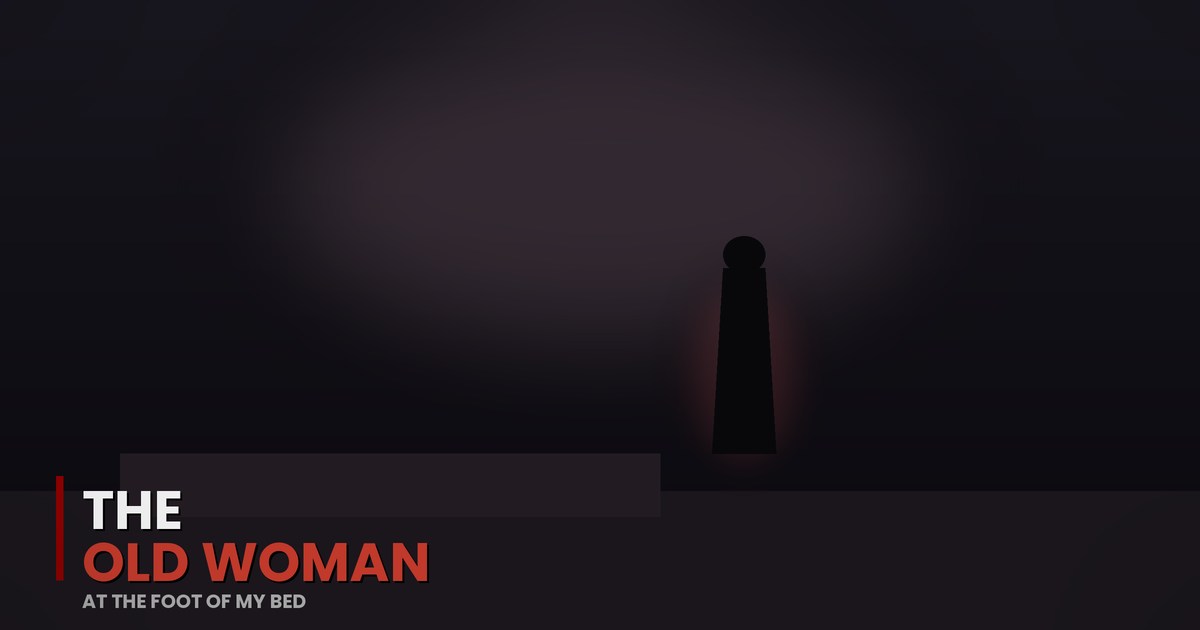
The first time I saw the old woman at the foot of my bed, I was certain I was dreaming. I woke in the dead of night, the way you sometimes do for no reason, and there she was — a small, hunched figure in a dark shawl, standing perfectly still at the foot of my bed, watching me in the darkness.
I couldn’t move. I later learned this is common in these moments — a kind of waking paralysis where the mind is awake but the body refuses to respond. But knowing the name for it doesn’t make it any less terrifying when you’re lying there, unable to move a single muscle, while something watches you from the dark.
She didn’t speak. She didn’t move toward me. She simply stood there, her head tilted slightly, studying my face with an expression I couldn’t read. After what felt like an hour but was probably only a minute, my body finally jerked free of the paralysis. I bolted upright, heart slamming — and she was gone.
She Kept Coming Back
I told myself it was sleep paralysis, a hallucination, nothing more. But she came back. Not every night, but often enough. Always the same: I’d wake, unable to move, and she’d be standing there at the foot of the bed in her dark shawl, watching me with that same unreadable expression.
Over time, strangely, my fear began to fade. She never hurt me, never came closer, never did anything but watch. I started to feel almost as if she were keeping a kind of vigil, though over what, I couldn’t say. I mentioned it, half-joking, to my mother during a visit.
The Photograph
My mother didn’t laugh. She asked me to describe the old woman — the shawl, the hunched posture, the way she tilted her head. The more I described, the paler my mother became. Without a word, she got up, went to her bedroom, and came back with an old photo album I’d never seen.
She opened it to a faded black-and-white photograph of an old woman in a dark shawl, hunched slightly, her head tilted at exactly the angle I’d described a hundred times. “That’s your great-grandmother,” my mother said quietly. “She died years before you were born. She always said she’d watch over the family’s children. She used to stand at the foot of our beds when we were small, just to make sure we were breathing.”
I don’t fear her anymore. When I wake now and find her standing there in the dark, I simply whisper, “I’m okay,” and after a moment, she nods, and she’s gone. Some watchers in the night mean us no harm at all. Some of them loved us long before we were ever born. I’ve since learned that my great-grandmother lost two of her own children young, back in a time when that was far more common than it should have been. Maybe that’s why she stayed — why she still walks from room to room in the dead of night, counting the breathing shapes in every bed, making sure each one is safe until morning. I have children of my own now. And sometimes, when I check on them at night, I feel her beside me in the dark, keeping her centuries-old watch alongside mine. I don’t mind the company. Love, it turns out, is the one thing that doesn’t end when a life does.
How scary was it?
More Scary Ghost Stories
 I Heard the Same Argument Upstairs Every Night Until One Night It Talked to Me
 Someone Leaves My Father’s Own Dahlias on His Grave Every Week
 Our EVP Recorder Caught a Voice Answering Our Questions, and It Was Mine
 We Moved Into a House With a Locked Room
 The Little Girl Who Visits My Daughter’s Room
 3 True Paranormal Encounters That Can’t Be Explained